Three months ago, the city of Maywood, California was headed towards bankruptcy. The city's Police Department alone was costing the town more than twice its total annual budget. Now, the town budget has been reduced by half and residents are ... thrilled?
That's because these days the parks are greener, civic space is better used, City Hall is running more smoothly, and violence has decreased. (Common Dreams) All of this (ostensibly) because in June of this year, the Maywood city council decided to contract out every one of the city's public services. The local police department was taken over by members of the LA County
Sheriff's Department, the neighboring city of
Bell was hired to perform services such as enforcing parking tickets, and so on.
Hearing of these plans, residents were initially quite concerned. As one resident told the New
York Times, "Senior citizens were afraid they would be assaulted as they walked down
the street. Parents worried the parks would be shut and their children
would have nowhere to safely play. Landlords said their tenants had
begun suggesting that without city-run services they would no longer
feel obliged to pay rent."
Today, approval is high. However, around the country the experiment still inspires controversy: is Maywood's example one of progressive ingenuity, or a betrayal of city employees and the tradition of civic involvement?

Showing posts with label The Economy. Show all posts
Showing posts with label The Economy. Show all posts
Tuesday, August 10, 2010


Monday, December 7, 2009
Recession Resolutions
The country didn't abandon political humor or become faithful church-goers after 9/11; we didn't maintain the sense of civic duty that brought 61% of voters to the polls for the 2008 presidential election (fewer than 30% voted in the NYC mayoral election); 20% of U.S. Americans still smoke despite the medical certainty that they're inviting cancer; and your uncle/aunt/ grandfather/ grandmother never did lose the weight after that heart attack.
We are what one could call a ... resilient people. Others would say stubborn. So what makes us think that the recession is going to create a long-term change in the way that we spend money?
In a New York Times article this weekend, economics professor Carmen Reinhard was quoted saying that even during the postwar years, which were defined by rationing and shortages, the savings don't last; "you get an increase in savings or a decline in debt for one or two years, and then it reverts back.”
So while pattern suggests that our cultural obsession with spending won't change drastically, there is an element of cold, hard truth that can change patterns whether the culture changes or not: for years after this recession, many people, even if willing, will be unable to borrow, due to a collapse in personal credit.
We are what one could call a ... resilient people. Others would say stubborn. So what makes us think that the recession is going to create a long-term change in the way that we spend money?
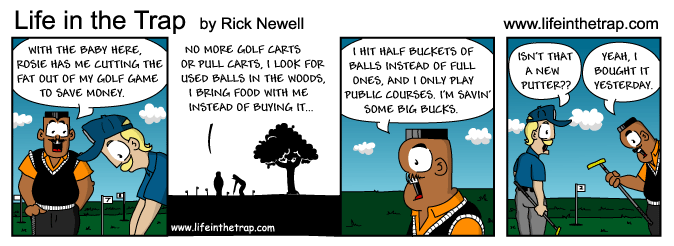
In a New York Times article this weekend, economics professor Carmen Reinhard was quoted saying that even during the postwar years, which were defined by rationing and shortages, the savings don't last; "you get an increase in savings or a decline in debt for one or two years, and then it reverts back.”
So while pattern suggests that our cultural obsession with spending won't change drastically, there is an element of cold, hard truth that can change patterns whether the culture changes or not: for years after this recession, many people, even if willing, will be unable to borrow, due to a collapse in personal credit.
Subscribe to:
Posts (Atom)